Getting to the heart of what matters in the Sawtooth National Recreation Area
Winter Tracks Tell Tales
Finding tracks any time of the year is fun, but winter is always my favorite time to track. Tracks that might be invisible in summer suddenly stand out clearly, and you can see the whole story of an animal’s movement before you arrived. There is interesting contrast in the fast emotions of excitement at first spotting a track and how we then slow down and engage more deeply with the landscape as we observe. We can take time to reflect and better understand how animals move and survive harsh winter conditions, and best of all, you don’t need special tools. Just curiosity, patience, and warm boots!
Tracks can tell us a lot of information about an animal, even if we don’t see it. General size, what direction it was moving, the speed it was traveling, what it might be doing (ex. hunting, grazing, etc.), and if the track is clear, you might be able to identify the animal that made it. In the winter, it can sometimes be easier to “read” the tracks or pattern of movement as there is less plant matter to break it up. On the flip side, conditions like thawing or icy crusts or even the depth of the snow and surface below can affect the shape of a track, distorting size and toe prints, making it more challenging to identify.
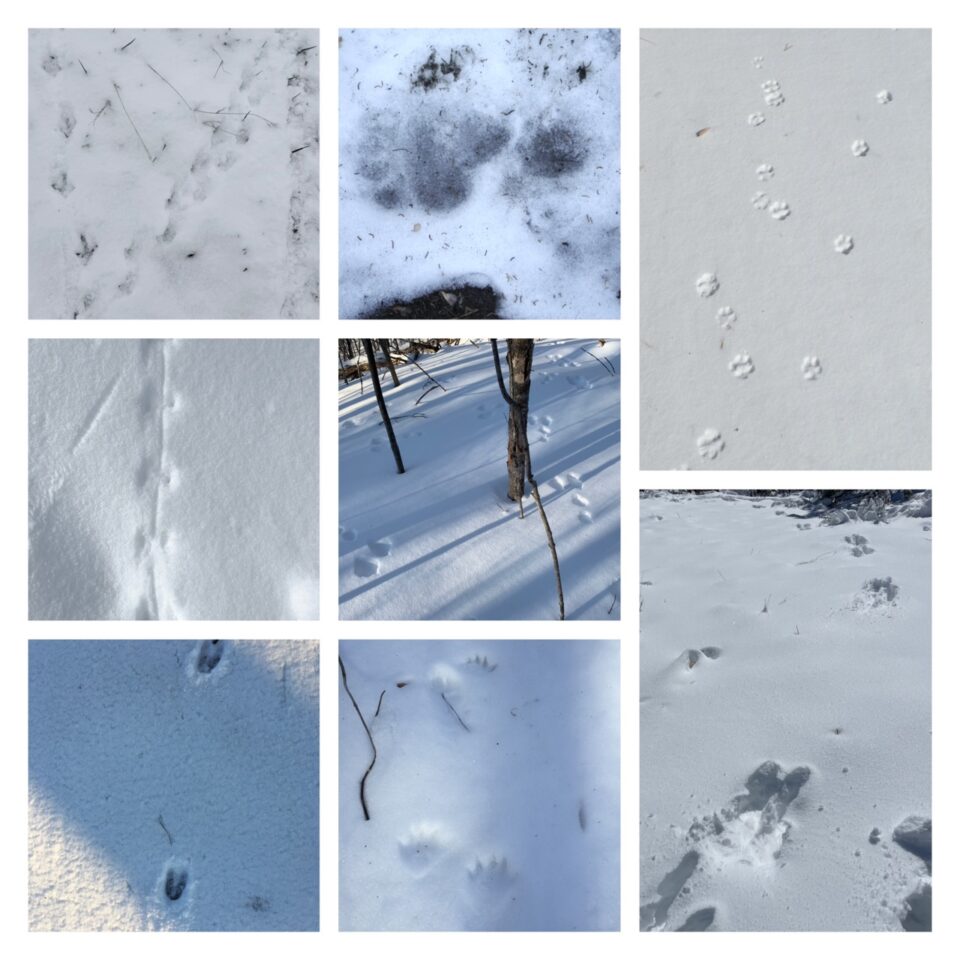
Various animal tracks in snow. By looking at the toes, distance between tracks, pattern of movement, size, and more we can start to build the story of what the animal was doing before we arrived. Photo credit: SIHA staff
When you first come across a track, pause, look around, and begin to visually gather more information. Tracking isn’t just about rushing to identify which animal made a print. It’s about asking questions and letting what you find guide you to a larger story.
Here are some basic questions you might consider:
Does the track seem small or large?
Are there more tracks in the area? If yes, do they seem to be from one animal or more than one animal?
How deep is the track – do I think the animal was heavy or light?
Can I see toes and determine which way the animal was moving?
Are the tracks close together or far apart, do I think the animal was walking, jumping, etc. based on the distance?
Does it have hooves or toes? Paws? Is it bird type toes (a W on a stick)?
Are there feathers, fur, wing marks, blood, scat, or other clues besides the track that might inform us of who was there and what was happening?
Tracks allow us to reconstruct moments in an animal’s life: where it came from, where it went, and what was happening around and for the animal. By slowing down and paying attention, we begin to see the winter landscape not as a quiet, dormant place, but as a landscape full of movement of the many wild animals in it. All it takes is curiosity, patience, and a willingness to look a little closer.
Tracking tip: take a picture of the track and your hand next to it. As well as the longer pattern of tracks. That way you can refer to them later when you have a guidebook or the internet available to help with identification.
Alicia is a naturalist and the 2025 Program Coordinator for SIHA. In summer, when not at the Redfish Visitor Center, you’ll find her hiking, making art, taking pictures, and swimming in cold water lakes and rivers with her husband, Jeff.