
Stargazing is an excellent year-round activity, but I’ve enjoyed the challenge of looking for constellations in the summer. It takes a lot of practice, and you have to be patient waiting for those long summer days to come to an end, but mapping out the night sky is incredibly rewarding. The cosmos have fascinated and inspired humans for millennia, from campfire stories and mythologies about how constellations came to be, all the way to modern astronomy and space exploration. So feel free to dig into that natural curiosity and try to map out the summer constellations for yourself!
You might’ve noticed that it’s a little easier to see the night sky out here than where you’re visiting from. That’s because the Sawtooth National Recreation Area is part of the Central Idaho Dark Sky Reserve (CIDSR). A dark sky reserve is a geographic area that is devoid of excess, man-made light, or light pollution. Established in 2017, the CIDSR covers 906,000 acres and encompasses the communities of Stanley, Lower Stanley, Ketchum, Smiley Creek, and Sun Valley as well as the entire SNRA.
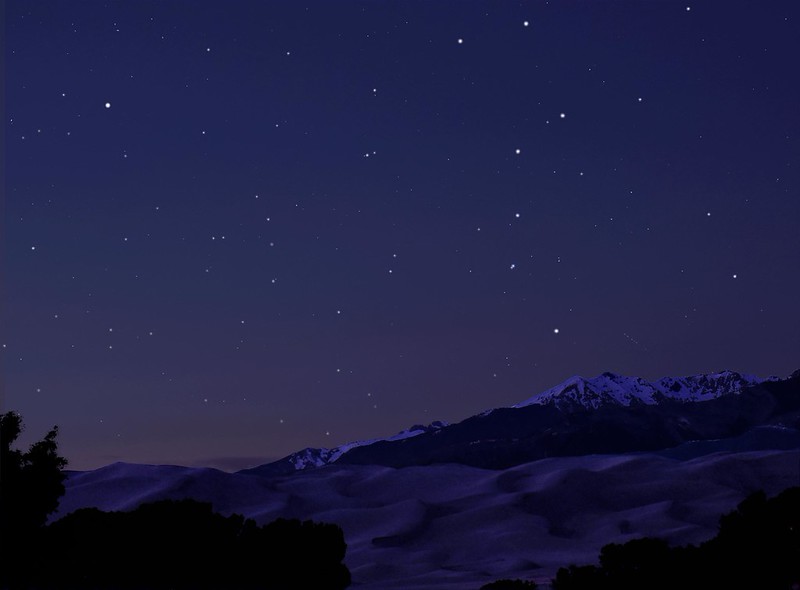
Here in the Sawtooths, there are constellations that you can see all year round, circumpolar constellations, in the northern sky, and a phenomenon to the east, the Summer Triangle. The five northern constellations you might already be familiar with: Ursa Major (the Big Dipper), Ursa Minor (the Little Dipper), Draco, Cassiopeia, and Cepheus. The Summer Triangle includes three constellations that are almost directly overhead in the eastern sky: Lyra, Cygnus, and Aquila. Each of these constellations has its own story behind its name and how, mythologically speaking, it came to occupy the night sky.
In Greek mythology, Ursa Major and Ursa Minor were once the nymph Callisto and her son, Arcas. After Zeus, the god of the sky, had an affair with Callisto and sired Arcas, he turned the nymph into a bear so that she would escape the wrath of his jealous wife, Hera. Years later, Arcas, now grown, was hunting in the woods when he came upon his mother. To prevent her slaying, Zeus turned Arcas into a bear cub, then threw the pair into the sky. Draco, the dragon that winds between the two bears, represents the dragon Ladon, once the guardian of the Garden of the Hespirides. Slain by Hercules as part of one of his 12 labors, Ladon was commemorated to the stars for his service. Cepheus and Cassiopeia are also connected in the night sky, the ancient king and queen of Aethiopia and the parents of Andromeda, who was sacrificed to the sea monster Cetus and saved by the hero Perseus.
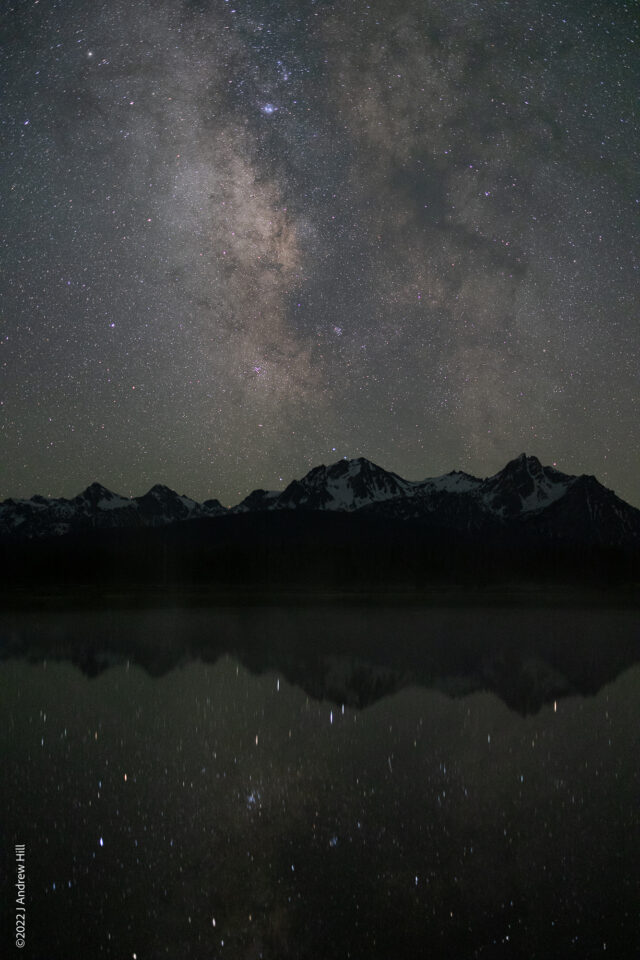
Photo Credit: Milky Way over Sawtooths by Andrew Hill, SIHA archives
The Summer Triangle also has its own set of stories. Lyra, or the harp, represents the magical lyre of the musician Orpheus. Cygnus, or the swan, commemorates Cygnus of Liguria, the devoted friend of Phaethon. Phaethon, the human son of the titan Helios, was struck down by Zeus to prevent catastrophe after a chaotic ride in his father’s chariot. After falling to the river Eridanus, Cygnus dove in relentlessly trying to find his friend’s remains. To honor his devotion, he was turned into a swan and placed in the night sky. Finally, Aquila, or the eagle, was famously the messenger of Zeus, and the carrier of his mighty thunderbolts.
Take advantage of these constellations of legend this summer and try your luck in finding them. If you want to check out the night sky through a high-powered telescope, the Sawtooth Observatory opened July 18th, 2026 in Pioneer Park in Stanley, ID. You can find when the next observatory event will be at https://idahodarksky.org/our-events/
Sources:
https://idahodarksky.org/about-the-reserve/
https://noirlab.edu/public/education/constellations/cepheus/
https://noirlab.edu/public/education/constellations/cassiopeia/
https://noirlab.edu/public/education/constellations/draco/
https://noirlab.edu/public/education/constellations/aquila/
https://noirlab.edu/public/education/constellations/lyra/
Christina Gibbs is a 2026 Naturalist with SIHA. When she’s not writing a blog or teaching a program, you can find her hiking to alpine lakes or staring at the night sky.