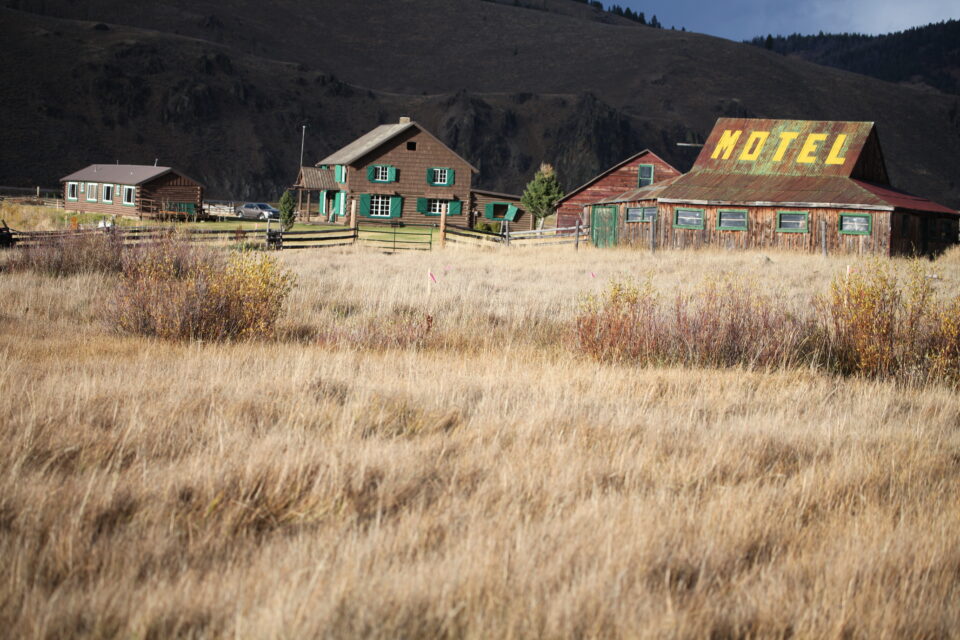
The Salmon River Hotel on the right (not described in article) constructed circa 1930.
Photo Credit: Historic Buildings Collection, SIHA Archives
The Sawtooth Valley and the surrounding Sawtooth National Recreation Area is a premier destination for tourists from across the country. Naturally, guests coming to the valley seek accommodations in the form of camping, hotels, restaurants, and cabins, all of which the Sawtooth Valley has a plentiful amount of. This short blog post will cover just a few of the different types of guest accommodations that early travelers utilized during their time in the Sawtooth Valley, as well as the development of those accommodations over the course of the past century.
Before the construction of multiple, dedicated lodgings in the early-20th century, visitors to the Sawtooth Valley often relied on the few permanent residents for shelter. In 1899, David and Louise Clarke became the first recorded homesteaders in the Sawtooth Valley. The couple made their home in the southern portion of the valley, establishing a residence in the vicinity of a hot spring which had been previously discovered and utilized before their arrival. However, by establishing a homestead near the hot springs the area became known as “Clarke’s Hot Springs”. As more people came to settle and traverse the Sawtooth Valley, the location increased in popularity, and the Clarke’s always welcomed those who happened to pass through the area with food and hospitality. Louise Clarke was said to have been an excellent cook. The table around which many residents and transient visitors alike gathered was usually well-stocked with homemade bread and warm meals for fortunate visitors.
In October 1902, Frank W. Shaw and his wife Catherine arrived in the Sawtooth Valley, where Frank was to work as a mining engineer at the Fisher Mine, located at the head of Fisher Creek. After two years in the valley, Frank and Catherine developed an admiration for the area and filed a land claim near Fisher Creek. They soon began construction with their son Preston on a ranch which would soon be widely known as “the friendly house.” Located in the vicinity of Clarke’s Hot Springs, the Shaw family residence came to extend a warm welcome to all those who were fortunate enough to pass by. The Shaw Ranch is notable for its guest book notes, which records visitors from every state in the Union, several foreign countries, and dignitaries alike. Among them, Senator William E. Borah (namesake of Idaho’s tallest mountain) in the summers of 1925-26.
Around the same time that the Shaws arrived in the Sawtooth Valley, Herbert Marshall, a prominent miner and businessman, began constructing a hotel at the mouth of Nip & Tuck Gulch, where a stage-coach road had been established which connected the Yankee Fork area to the upper Sawtooth Valley. The “hotel”, as nearby residents called it, was the first building in what would eventually become Lower Stanley. The accommodations here were rather simple, comprising three rooms and a lean-to bedroom which served as living quarters and a dining room. It could more appropriately be described as a boarding house rather than a proper hotel. While built by Herbert Marshall, it is not entirely clear who managed the lodging, with the duties changing hands a number of times before the building was torn down in 1931 and its boards being used for firewood.
Though the hospitality provided by the locals of the Sawtooth Valley was reasonable, guest lodging soon appeared a lucrative business for some families in the valley. Chief among them were the Benners, who in 1912 constructed a two-story log building above Valley Creek within the vicinity of modern day Highway 21 in Stanley. The building was constructed by two local men, Tom Williams and Arthur Wright, and came to be managed by Mrs. Martha Benner for the duration of its existence. The Benner hotel was the first building to host electricity in the valley beginning in the spring of 1913, powered by a small dynamo, and hosted 13 rooms, 2 sitting rooms, a piano and dance floor, and food provided by Mrs. Benner. The Benner hotel served as a venue for social gatherings in the Sawtooth Valley, as well as a classroom for nearly three decades, before being demolished in 1942.
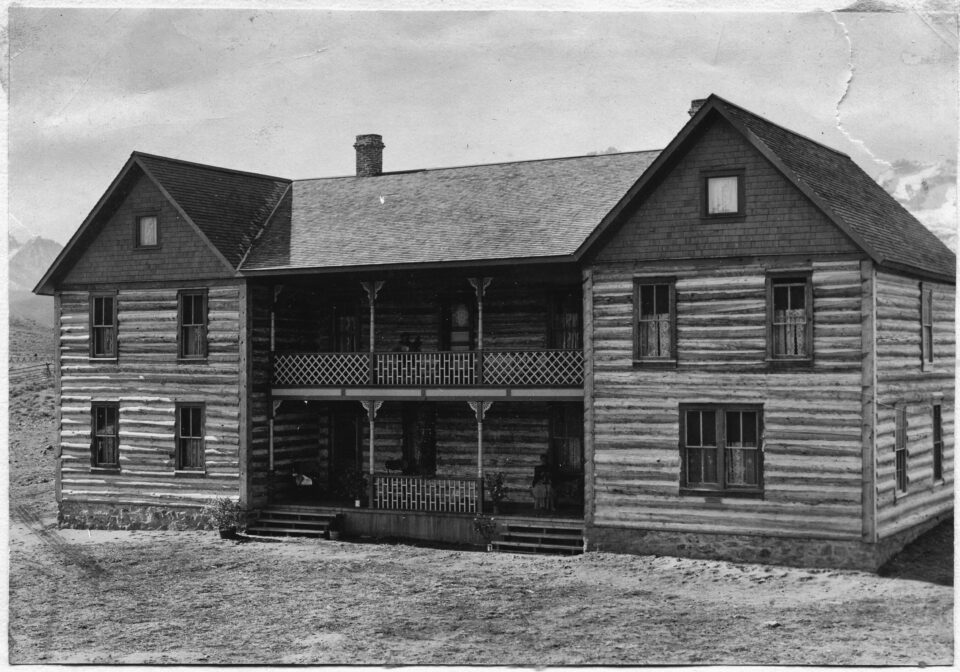
The Benner Hotel in 1913
Photo Credit: Jim Banks Benner Hotel Collection, SIHA Archives
After the Second World War, many of the mines that had developed the Salmon River country fell silent, and tourism became the dominant economic force in the region. While many of the early lodgings have been demolished or are no longer serving guests, the earliest settlers in this area recognized the importance and potential of providing hospitable accommodations to visitors. While this short article only highlights a few of the earliest examples of guest accommodations in the area, they serve to demonstrate the enduring and age-old spirit of mountain hospitality in the Sawtooth Valley.
Works Cited
Yarber, Esther and McGown, Edna. Stanley-Sawtooth Country. 1976.
Brady Cooke is a Historic Specialist at the Stanley Museum for the Sawtooth Interpretive and Historical Association. Born and raised in southern Idaho, in his free time he enjoys hiking, fly-fishing, and camping throughout the Sawtooth-Salmon River Country and southern Idaho.