
The Sawtooths are full of specialists. Some animals are built for speed, others for strength, and some for life almost entirely out of sight. But few families show that diversity better than the mustelids.
Long-tailed weasels, badgers, river otters, and wolverines all come from the same evolutionary blueprint. Each belongs to the family Mustelidae, better known as the weasel family. Although mustelids vary dramatically in size and habitat, they all share a similar body plan: long bodies, short legs, thick necks, sharp teeth, and scent glands used for communication and survival. From that design, evolution has produced predators that dominate completely different worlds. From underground burrows to fast-moving rivers to high mountain snowfields, mustelids have adapted to nearly every habitat in the Sawtooth ecosystem.
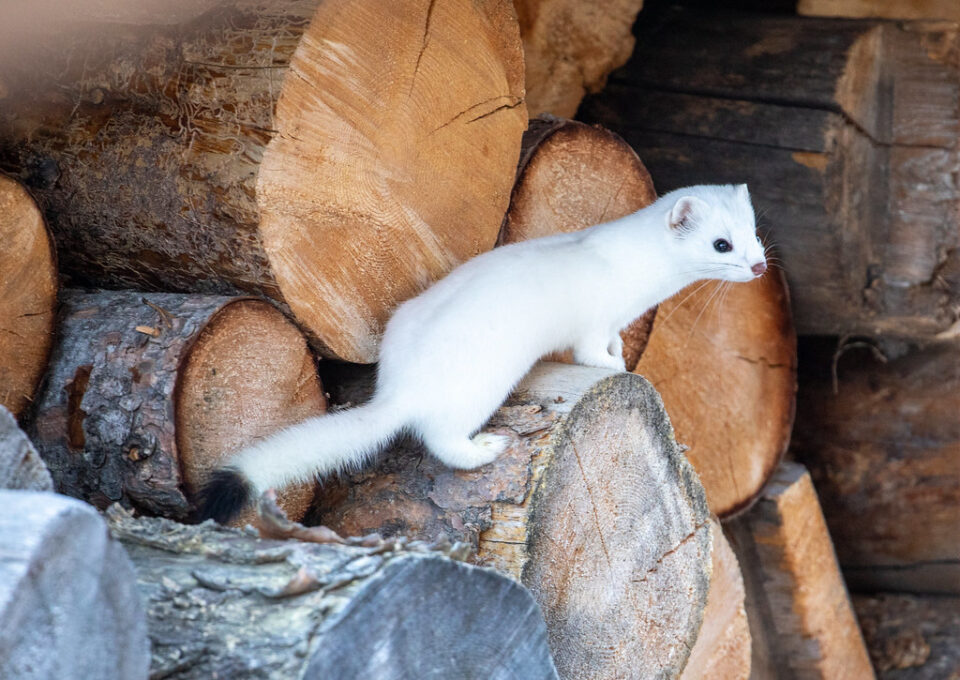
The long-tailed weasel is the largest of the three American weasels. Photo Credit: “Long-tailed weasel” by YellowstoneNPS is marked with Public Domain Mark 1.0.
One of the smallest mustelids in the Sawtooths is the long-tailed weasel (Mustela frenata), but don’t let its size fool you. Measuring just over a foot long, it is one of the most efficient predators in North America. Its slender body allows it to chase prey into underground burrows where larger predators cannot follow. Once inside the burrow, it delivers a quick bite to the back of the prey’s neck. Long-tailed weasels hunt mice, voles, pocket gophers, squirrels, and even rabbits that significantly outweigh them. To fuel this active lifestyle, they must eat roughly 20 to 40 percent of their body weight every single day. Their hunting tactics are not the only interesting thing about them – their coat also changes with the seasons! They blend into brown grasses during the summer before turning white in the winter. Only the tip of their tail remains black year-round.
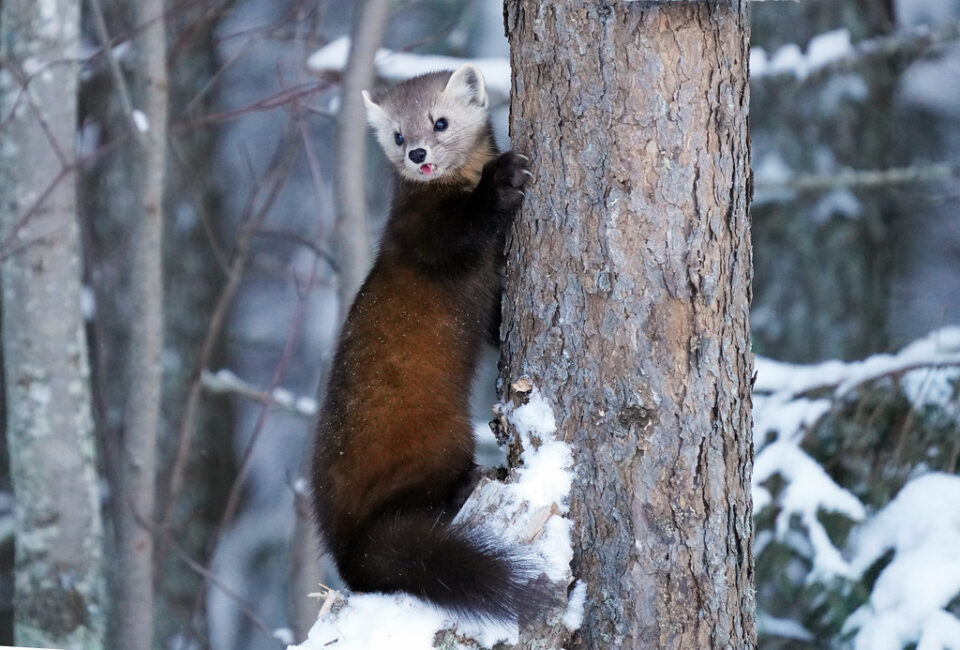
Martens like to build their dens inside of empty tree hollows. Photo Credit: “American marten” by U.S. Fish and Wildlife Service – Midwest Region is marked with Public Domain Mark 1.0.
Higher in the conifer forests lives the American marten (Martes americana), also known as the pine marten (although they are actually different species). With a long tail for balance, cat-like ears, and sharp claws, martens move through the forest with incredible agility. They zigzag across fallen logs, leap effortlessly between branches, and chase prey into treetops. In winter, long hairs grow between the pads of their feet, helping them travel across deep snow while keeping their toes warm. Although they primarily hunt squirrels, chipmunks, voles, rabbits, and pika, martens are not picky eaters. They will also snack on berries, insects, bird eggs, and carrion (dead animals) when the opportunity presents itself.
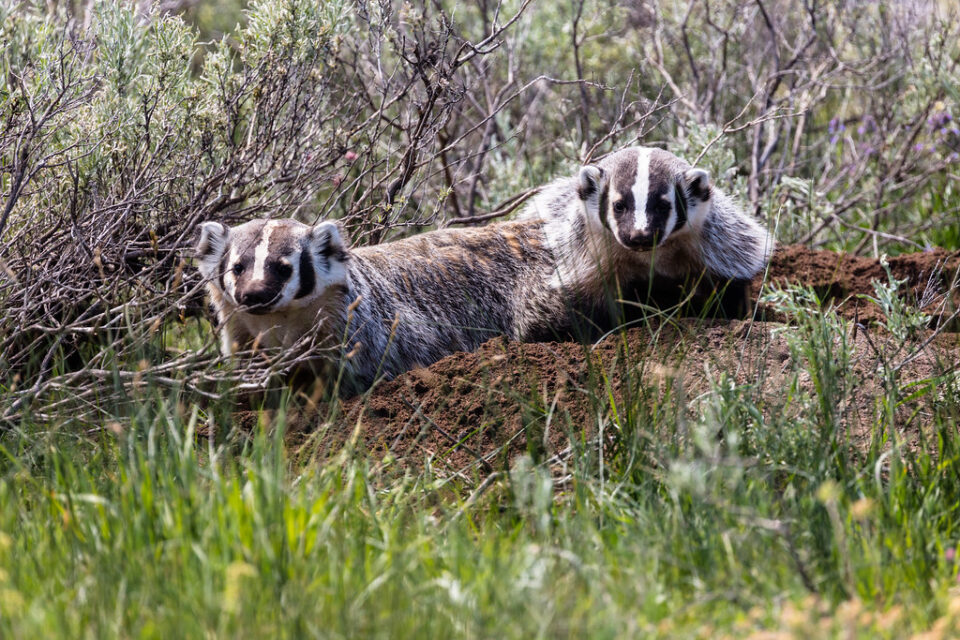
The stripes on badgers’ faces act as a warning signal to predators, also known as aposematism. Photo Credit: “Badgers digging near Indian Creek Campground” by YellowstoneNPS is marked with Public Domain Mark 1.0.
Unlike martens, American badgers (Taxidea taxus) rarely climb trees. Instead, they have mastered life underground. Badgers are built like miniature bulldozers. Their broad shoulders, muscular forelimbs, and front claws, which can reach two inches long, allow them to dig with astonishing speed. Rather than waiting patiently for prey to emerge, badgers simply excavate entire tunnel systems, often plugging secondary exits with dirt to trap rodents underground. They have even been observed hunting alongside coyotes. Coyotes chase prey above ground while badgers pursue them below, increasing the hunting success of both species. Their digging does not just benefit themselves, either. Abandoned badger burrows become homes for countless other animals, and their constant digging habits help aerate the soil.
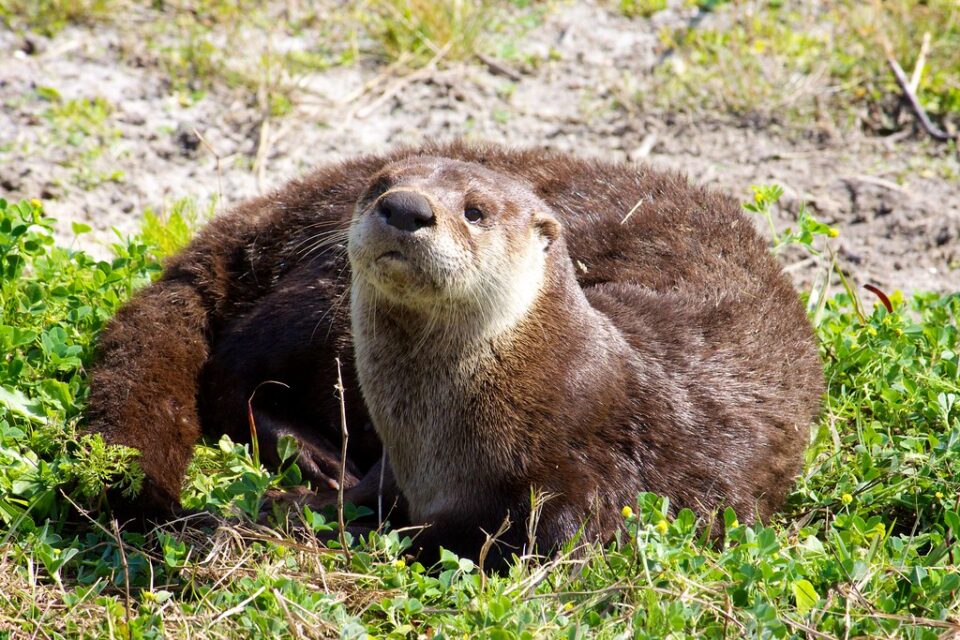
River otters do not build their own homes, but rather steal abandoned beaver lodges and muskrat dens. Photo Credit: “North American River Otter (Lontra canadensis)” by USFWS/Southeast is marked with Public Domain Mark 1.0.
Swap open grasslands for rivers, and you will find the fan favorite of the weasel family. North American river otters (Lontra canadensis) have streamlined bodies, webbed feet, dense waterproof fur, and sensitive whiskers that help detect fish beneath the water’s surface. They can remain underwater for up to eight minutes, dive nearly 60 feet deep, and even close their ears and nostrils while swimming. River otters are perhaps best known for something besides their hunting abilities: they love to play. Sliding down muddy riverbanks and snowy hillsides is not just for entertainment. Play helps strengthen social bonds and gives young otters valuable practice for life as hunters.
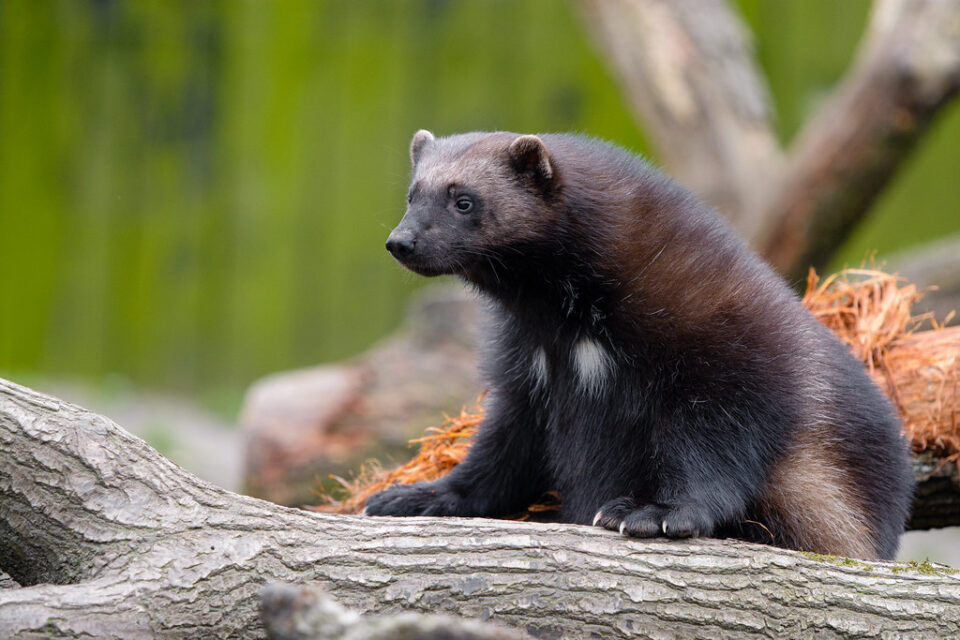
Wolverine claws are typically four inches long. Photo Credit: “Wolverine” by Mathias Appel is marked with CC0 1.0.
At the opposite end of the size spectrum is the wolverine (Gulo gulo), the largest land-dwelling member of the weasel family and arguably the most elusive predator in the Sawtooths. Wolverines roam enormous home ranges that can span hundreds of square miles. Thick fur, powerful claws, and oversized feet allow them to travel across deep mountain snow with surprising ease. They hunt rodents when possible but are equally skilled scavengers, feeding on the remains of deer and elk left behind by other predators. Their dependence on deep spring snow makes them especially vulnerable to climate change. As snowpack melts earlier each year, suitable denning habitat continues to shrink, contributing to the species’ listing as threatened under the Endangered Species Act.
Although each of these animals has taken a different evolutionary path, they all play an important role in keeping the Sawtooth ecosystem healthy. Together, mustelids act as regulators of the food web. Long-tailed weasels, martens, badgers, otters, and wolverines help keep prey populations in check, especially small mammals that can quickly become overabundant without predators. In doing so, they help maintain balance across forests, grasslands, rivers, and alpine environments. In order to do this, these animals need intact forests, clean rivers, open meadows, and deep mountain snowpack to provide the specialized habitats they depend on.
The next time you are in the Sawtooths, chances are you won’t spot a mustelid. Most are secretive, fast, and particularly good at avoiding people. But knowing they are out there changes the way you experience a landscape. A pile of fresh dirt in a meadow might mark a badger’s last excavation. Tracks weaving through the snow could belong to a marten or wolverine. A smooth slide into a riverbank may reveal that an otter passed by not long before you did. They may all belong to the same family, but each has found its own remarkable way to call this place home.
Resources:
https://www.nps.gov/jeca/learn/nature/long-tailed-weasel-mustela-frenata.htm
https://www.nps.gov/articles/000/american-marten.htm
https://www.nationalgeographic.com/animals/mammals/facts/american-badger
https://www.nwf.org/Educational-Resources/Wildlife-Guide/Mammals/North-American-River-Otter
https://www.nwf.org/Educational-Resources/Wildlife-Guide/Mammals/Wolverine
Addie is a 2026 Naturalist who has been visiting the Sawtooths since childhood, so she may be a bit biased when she says it’s the most beautiful place in the world. When she’s not working, she loves to hike and explore the area as much as possible.