Working two summers as a historic specialist in Stanley, you develop a lot of knowledge that is not necessarily historical. While I do get to inform folks about how the Sawtooth NRA came to be and the fascinating world of land management legislation, I also get to inform them on where the Valley Creek Hot Spring is located, or where the bathroom is, and I’ll gladly share that information!
However, when I’m not telling people about history, where to recreate, or where to defecate, I’m often asked about a completely different, but nonetheless important topic, pertinent to the SNRA–nature! Gasp! Eek! Don’t we have naturalists for this?! “Go to the Redfish Visitor Center,” I say in a panic, “away from my ineptitude!”
“Now, Eoin, you need not panic; you are prepared for such situations,” I assure myself. In the realm of visitor information, you must learn to be comfortable with admitting, in all honesty and with your head held high: “I don’t know.” How can you remedy this? Simple: follow up with, “but I can find that information for you.”
Here’s what is good about that remedy: not only does it help the visitor, but it also helps you. If someone asks that question in the future, you’ll be prepared! “No fear, knowledge is here!” Or, as has happened to me, you can end up down a rabbit hole that galvanizes you to invest in learning a part of the Sawtooth NRA that isn’t exclusive to the history books, like:
Dams! Eight of them, to be exact, on the Columbia and Lower Snake Rivers. I’m not here to voice an opinion one way or the other on the dams, but my exhibit work this summer has gotten me well versed (or so I’d like to think) on their impacts. Dams do a number of things to the water: they create reservoirs, slack water (halted current), and siltation (sediment pollution of the water). All of these, then, impact the different anadromous fish in the Sawtooth NRA that migrate from here to the Pacific Ocean. These include species that spawn here in the Sawtooths like sockeye, Chinook, and steelhead; sockeye in particular are keystone species in this ecosystem, and are intertwined with the identity of the Sawtooths. They may end up in the reservoirs, become susceptible to predation, or suffer under increased temperature.
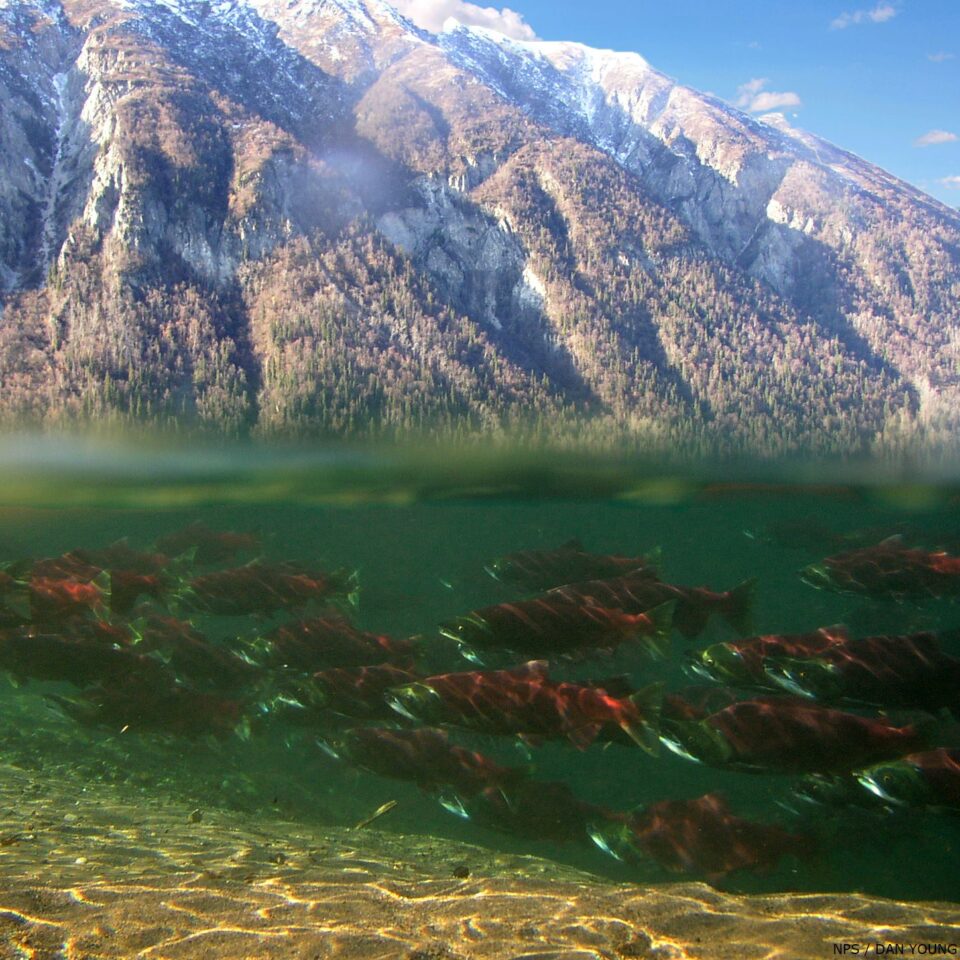
Sockeye school at the Lark Clark National Park and Preserve in Alaska–what Redfish Lake may have looked like once upon a time! Photo Credit: “Sockeye School” by LakeClarkNPS is marked with Public Domain Mark 1.0.
Sometimes, though, learning beyond the history of the Sawtooth NRA comes not from the needs of the job, but personal interest. If you head out on Highway 21, hike to the Bench Lakes, or go down by the headwaters for the Salmon River, the presence of burn scars is a stark contrast to the vast amount of the unburned land. Dead trees, ashy soil–signs warn of the risks associated with these burn areas: falling trees, falling branches and limbs, and flash flooding.
“Flash flooding? After a burn?” I ask in my naturalist inept dialogue. It may seem odd how a burn–an impact of fire–increases the risk of flood–an impact of water. This contradiction piqued my interest; turns out, it isn’t a contradiction at all, but a reminder of how much forests protect watersheds–especially after observing the Grandjean mudslide on Highway 21, in an area scarred from the Wapiti fire of 2024.
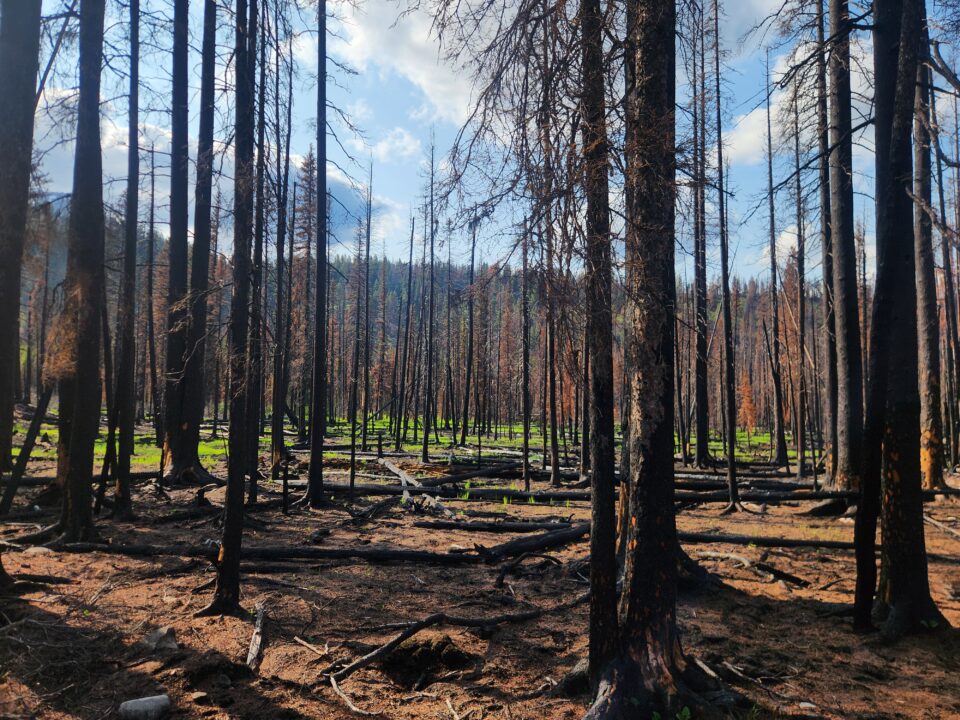
Scene from after the Wapiti Fire–burnt trees, fallen debris, and new meadows up ahead. Photo Credit: SIHA Staff
Soil absorbs water–obvious, right? When soil burns so hot and for so long, it becomes so dried out that water cannot permeate it; therefore, the water can’t go down into the ground. That, combined with the lack of forest canopy and undergrowth that would also absorb water, means that it takes a small amount of water–half an inch in an hour–to create flash flood risk. That water ends up absorbing into its stream what ash and debris (like fallen tree limbs) has accumulated onto the ground, contributing to a chaotic flow of water.
Now, I still cannot claim to be an expert on every natural element here in the Sawtooth NRA. I am hopeless when it comes to geology; hey, though–at least I know what crepuscular means! Learning about the dams and the life histories of these fish, I have been able to develop a better understanding of the place I love, its ecosystem, and what challenges it faces. Similar, understanding wildfire impact helps me understand a recent event in the Sawtooths that has been detrimental. Push come to shove, though, I may still send people to the visitor center: “tell ‘em Eoin sent ya.”
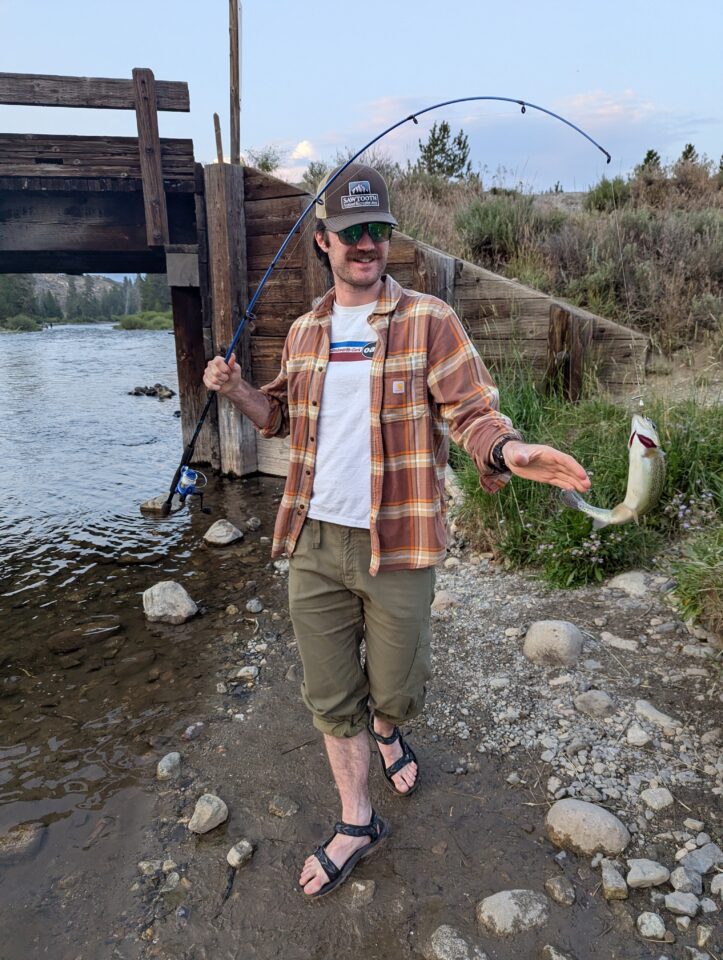
What he may lack in some naturalist knowledge, he unfortunately doesn’t make up for it in his ability to gracefully catch a fish. Photo Credit: SIHA Staff
Eoin Gleeson is a returning staff member to SIHA, as a 2025 Historic Specialist and 2026 Lead Historic Specialist. During the summer, when he isn’t at the Stanley Museum learning more area history and educating visitors, he enjoys road trips, fishing, and eating copious amounts of Papa Brunee’s Pizza.