
After two prior seasons here in the Sawtooths, I had a new and exciting experience this summer. On a hike to the Bench Lakes, I discovered a creature from my childhood that I did not know lived in the Sawtooth NRA: the cicada! I grew up in Oklahoma, and the song of the cicada holds wonderful memories for me of hot days and warm summer nights, so hearing them that day, and for weeks after, was both familiar and surprising.
The cicadas we find here aren’t the same ones I grew up hearing in the rolling hills of eastern Oklahoma, but they all belong to the family Cicadidae. There are a number of different genera across North America, with Idaho Fish and Game currently recognizing three genera of cicadas in the state: Okanagana, Platypedia, and Neoplatypedia. Of Idaho’s cicadas, the genus Okanagana contains the greatest diversity of species, including species found in mountainous environments like the Sawtooth NRA. This includes the mountain cicada, Okanagana bella, as well as other species such as O. canadensis, O. napa, O. occidentalis, and O. rimosa. Identifying cicadas to species can be difficult. Closely related Okanagana species can look very similar, and researchers may use details of their anatomy or even their distinctive calls to tell them apart. The small, dark cicadas I saw here in the Sawtooths in June appeared consistent with this group, but even with photos and video recordings of their calls, assigning them to a particular species would be uncertain. While their exact identity may be difficult to determine, these cicadas share the same basic life cycle, one that is largely hidden from us beneath the soil.
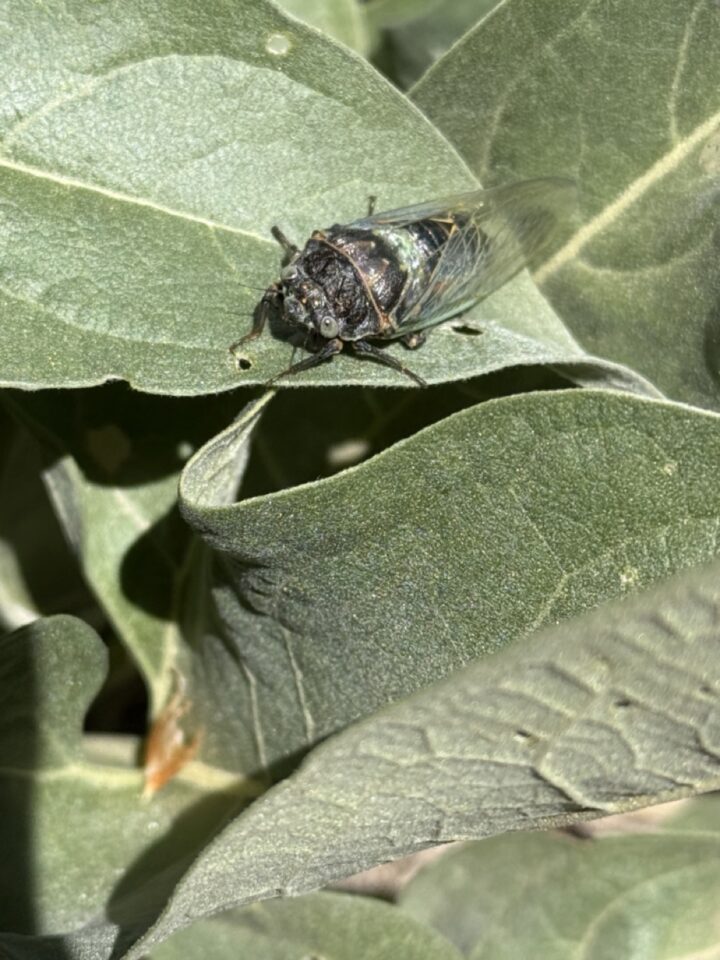
A recently emerged adult cicada. Photo credit: SIHA staff
The winged cicada we see during summer, and hear making its recognizable droning call, represents only a short portion of its life. Let’s begin with the egg and circle back to the winged adult. Female cicadas deposit their eggs in small slits they cut into twigs or stems. After hatching, the tiny young insects, called nymphs, drop to the ground and burrow into the soil, where they feed on fluids from plant roots using specialized piercing mouthparts. As the nymph grows, it passes through several developmental stages underground. Cicadas undergo what is known as incomplete metamorphosis. Unlike a butterfly, which develops from egg to larva to pupa to adult, a cicada grows through a series of nymphal instars, shedding, or molting, its inflexible exoskeleton as it gets larger. Cicadas generally have five nymphal instars, and most of those molts occur underground, so we do not normally see the discarded exoskeletons. When the nymph reaches its fifth instar, it comes above ground, climbs a plant or other surface, and undergoes its final molt, emerging as a winged adult. Over the next several hours, the newly emerged, or teneral, adult rests while its new exoskeleton hardens through a process called sclerotization. At first it is soft and pale, with crumpled wings. Fluid is gradually pumped through the wings to expand them, while the body hardens and the adult coloration darkens. The empty nymphal skin left behind is called an exuvia, and these hollow shells are often easier to find than the cicadas themselves. Once the wings and exoskeleton have hardened, adult cicadas fly into nearby vegetation. Males begin producing their species-specific calls to attract females, mating follows, and females eventually lay eggs, beginning the cycle again.
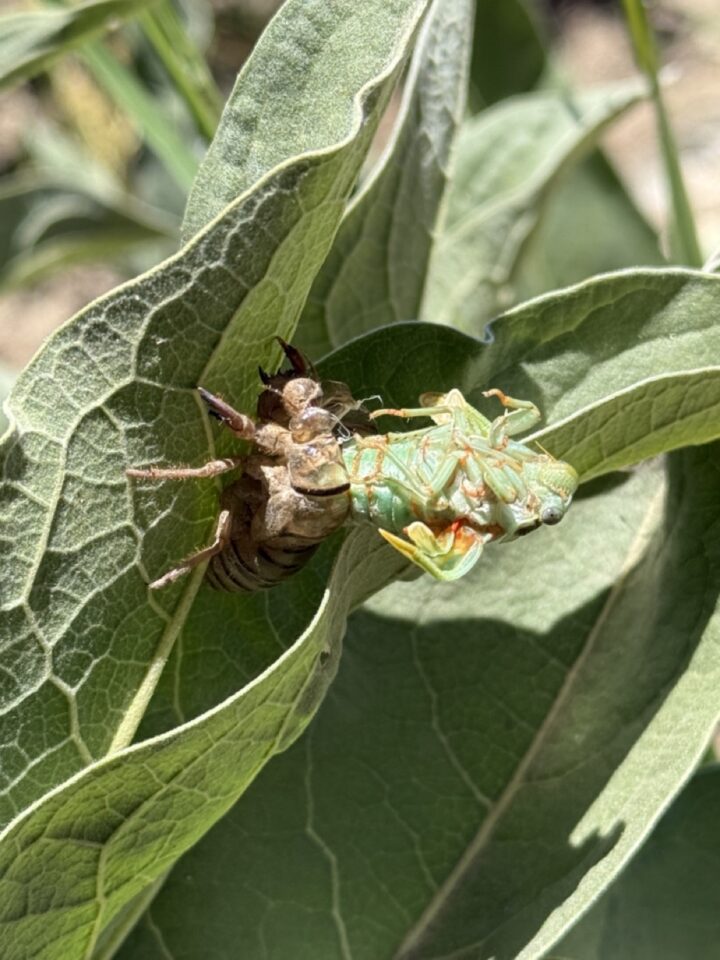
A cicada emerging from it’s exoskeleton. Note the pale color and soft wrinkled wings. The color will darken and wings expand and harden over several hours. Photo credit: SIHA staff
Unlike the 13- and 17-year periodical cicadas of the eastern United States, our western cicadas are considered annual, or nonperiodical, cicadas. This does not mean an individual cicada lives for only one year. Instead, different generations develop underground on overlapping schedules. Individuals do not all emerge at once, so new adults may continue appearing, and their calls may be heard for weeks during the summer. Periodical cicadas, by contrast, synchronize their development, with members of a brood emerging together in large numbers after 13 or 17 years underground. This year, I first heard cicadas in the Sawtooths in mid-June, and by the end of July their calls had disappeared. The timing of cicada activity is influenced by environmental conditions, including temperature, although the specific cues that govern emergence vary among species. Once adults begin emerging, new individuals may continue to appear for several weeks before the population completes its brief above-ground reproductive season.
The sound that makes cicadas so recognizable is primarily a mating signal. Male cicadas produce their calls using structures called tymbals, ribbed membranes on the abdomen that are rapidly flexed by specialized muscles. Different cicada species produce different calling songs, which can help females recognize males of their own species. Research on Okanagana cicadas has also shown that calling behavior can be influenced by environmental conditions such as temperature and sunlight. That makes their association with warm summer afternoons more than just a human impression; their activity really is closely tied to the conditions around them. Scientists are still learning about western cicadas, but for me, simply discovering that they live here at all has been a new experience. Hearing their song this summer brought an extra layer of joy to my time in the Sawtooths. Their summer has already come to an end, but I hope that next year you have the opportunity to hear the sweet drone of our little Sawtooth cicadas.
Alicia is a naturalist and the 2026 Program Coordinator for SIHA. In summer, when not at the Redfish Visitor Center, you’ll find her hiking, making art, taking pictures, and swimming in the cold lakes and rivers with her husband, Jeff.