
How do we protect an animal that almost nobody sees? The wolverine (Gulo gulo) is arguably the most elusive animal in the SNRA, but they’re not living easy right now. Climate change and an increase in outdoor recreation have led to functional habitat loss and other changes in wolverine behavior, so I sat down with Chris Klingler, a wildlife technician/field biologist with the U.S. Forest Service, to discuss what exactly is happening to Sawtooth wolverines right now, and what we could possibly do to help them.
The wolverine is the largest land-dwelling member of the weasel, or mustelid, family. They stand about 14-18 inches tall from the foot to the top of the shoulder, the males weighing in anywhere between 26-40 pounds, the females 17-26 pounds. They have a thick, dark brown coat with two paler stripes that run from the nape of the neck, along the flanks, to the base of the tail. They can sometimes have white or orange patches on the chest and throat, and differing color patterns can help scientists (or casual observers) identify individuals. The tail is long, dark brown, and very bushy. Like other members of the weasel family, wolverines also have shorter legs and five toes on each foot. However, their feet are huge compared to their body size (about the same size as a gray wolf’s) with four inch semi-retractile claws meant for digging in snow and climbing trees. Wolverines are primarily scavengers, making their living sniffing out carcasses from larger predators like bears, wolves, and mountain lions.
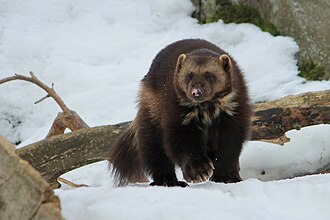
Wolverines, commonly confused with badgers, are the largest member of the weasel family. “File:Wolverine (Gulo gulo), Korkeasaari.JPG” by Uusijani is marked with CC0 1.0.
Here in North America, wolverines can be found in Idaho, Montana, northern Wyoming, the North Cascade Mountains in Washington state, Alaska, and parts of Canada. Here in Idaho, they range from the South Fork of the Boise River north to the Canadian border, the Selkirk Mountains in the Panhandle, and the Sawtooth and Smoky Mountains. They prefer the arctic tundra, the subalpine tundra, and boreal forests. In the lower 48, wolverines are more prevalent in higher altitudes because the higher up the mountain they travel, the more access they’ll have to deep, persistent spring snowpack, which is necessary for denning females. Wolverines don’t occur where the average daily maximum temperature exceeds 70 degrees Fahrenheit. In short, they like it cold and remote.
The home ranges of wolverines can be quite large, anywhere between 100-900 square kilometers, so they naturally occur at low population densities. Within the 756,000 acres of the SNRA, there are only about 8 individual wolverines, according to Klingler. The range of one male wolverine encompasses the entire Sawtooth mountain range, he said. Wolverines also have an incredibly high metabolic rate, even for a member of the weasel family, so they’re constantly on the move. They can travel 20 miles a day patrolling their territories or searching for food. True to their elusive nature, wolverines aren’t sighted by locals or visitors very often. According to Klingler, they’re more likely to be sighted in the White Cloud Mountains. Keep in mind, wolverines want nothing to do with people, and their sense of smell is incredible. They’ll get a whiff of you before you even know they’re around and they’ll go somewhere else.
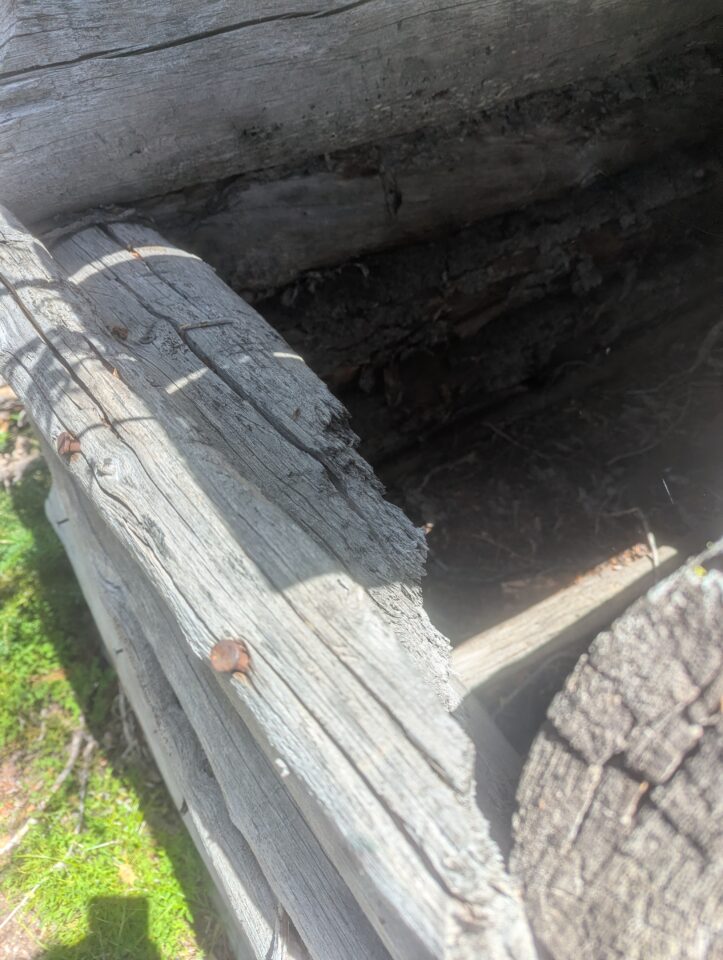
Wolverine claws are four inches long, acting like crampons on the ice and snow, but can cause some serious damage to traps. Photo credit: SIHA Staff.
So how will a scavenger built for the ice and snow fare in a warming world? Listed as “threatened” under the Endangered Species Act, in Idaho, wolverines aren’t in decline yet, but seem to be standing on the precipice. “Most researchers say [there are] three to four hundred [wolverines] in the lower 48,” Klingler said, but he thinks that number might be closer to 250-300 individuals. It doesn’t help that because wolverines occupy such rugged landscapes, they can be difficult to study. It’s hard to get a clear picture on how they’re doing. “You’d have to have a project that spans a couple of years, a pretty big chunk of time, to catch enough [data] to come to any conclusions that are statistically relevant,” said Klingler. Klingler’s wolverine project, through the U.S. Forest Service, was supposed to span five years, starting in 2024. But then things changed and funds were pulled from the project. Fortunately, Idaho Fish and Game came through with some funds for camera and hair snare work to take place this winter, said Klingler.
Any work that can be done for wolverines counts. Wolverines, as an indicator species, inadvertently let us know how our climate is doing. “In some ways, they’re the canary in the coal mine,” Klingler said. In the same way that the plight of polar bears shows us the dangers of thinning pack ice in the Arctic, wolverines, or a lack thereof, tell us about the struggles our alpine ecosystems are facing. “We don’t want them to go away, that’s a clear sign of bad things to come.” That being said, rising temperatures aren’t making their push for survival easy. Prior to our conversation, Klingler had been on a backpacking trip the last three days, and he even noticed a temperature difference. “Up high, it was warmer than down low.”
So what can we do? It’s easy to feel hopeless in the face of what many call a climate crisis, but I’m of the mind that giving in to hopelessness leads to complete inaction. So let’s try some things to help our gulos before it’s too late. Based on existing data detailing where female wolverines den, we could potentially close off certain areas to recreation during the denning period. That way, we don’t add excess stress to females while they’re nursing kits and searching for food. In addition, we, as backcountry recreators, can afford to take shorter pauses when traversing through those higher alpine ecosystems. Catch your breath, drink some water, take a quick picture, then move on. Those wolverines need the space just as much as we do, and they’re much more picky about who they see on the trail.
Try out these ideas the next time you’re in wolverine territory and we’ll see if we can’t give these tenacious carnivores the fighting chance they deserve.
Sources:
Conversation with Chris Klingler, Forest Service Wildlife Technician
Banci, V. (1994). Wolverine. In: Ruggiero, Leonard F.; Aubry, Keith B.; Buskirk, Steven W.; Lyon, L. Jack; Zielinski, William J., tech. eds. The scientific basis for conserving forest carnivores: American marten, fisher, lynx, and wolverine in the western United States. Gen. Tech. Rep. RM-254. Fort Collins, CO: US Department of Agriculture, Forest Service, Rocky Mountain Forest and Range Experiment Station. p. 99-127, 254. https://research.fs.usda.gov/download/treesearch/27330.pdf
Bonamy, M., Herrmann, T. M., & Harbicht, A. B. (2020). ‘I think it is the toughest animal in the North’: human-wolverine interactions among hunters and trappers in the Canadian Northwest Territories. Polar Geography, 43(1), 1-24.
Chadwick, D.H. (2010). The Wolverine Way. Patagonia Books.
Heinemeyer, K., Squires, J., Hebblewhite, M., O’Keefe, J. J., Holbrook, J. D., & Copeland, J. (2019). Wolverines in winter: indirect habitat loss and functional responses to backcountry recreation. Ecosphere, 10(2), e02611.
https://esajournals.onlinelibrary.wiley.com/doi/pdfdirect/10.1002/ecs2.2611
Christina Gibbs is a 2026 Naturalist with SIHA. When she’s not writing a blog or teaching a program, you can find her hiking to alpine lakes or staring at the night sky.