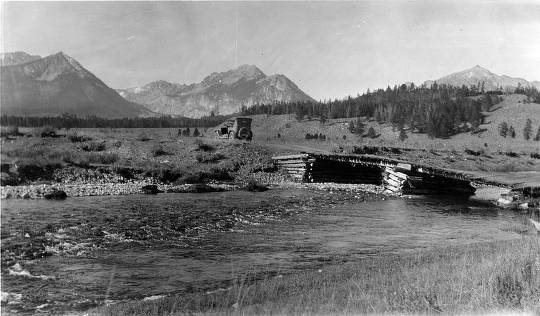
Galena Summit Road Bridge Over Salmon River (Photo from ITD Public Archives)
By the 1890s, the routes that would become Idaho State Highway 21 & 75 had been well established. Last week’s blog discussed how and why those paths came to be. This blog continues the story, focusing on how the roads were continually improved to serve our current age of automobiles. The construction and maintenance of highways throughout Idaho is subject to the force that dictates all governmental efforts: funding. While Highway 21 & 75 will be highlighted periodically, the build-up of these highways falls into the broader context of historic road policies at the state and national levels.
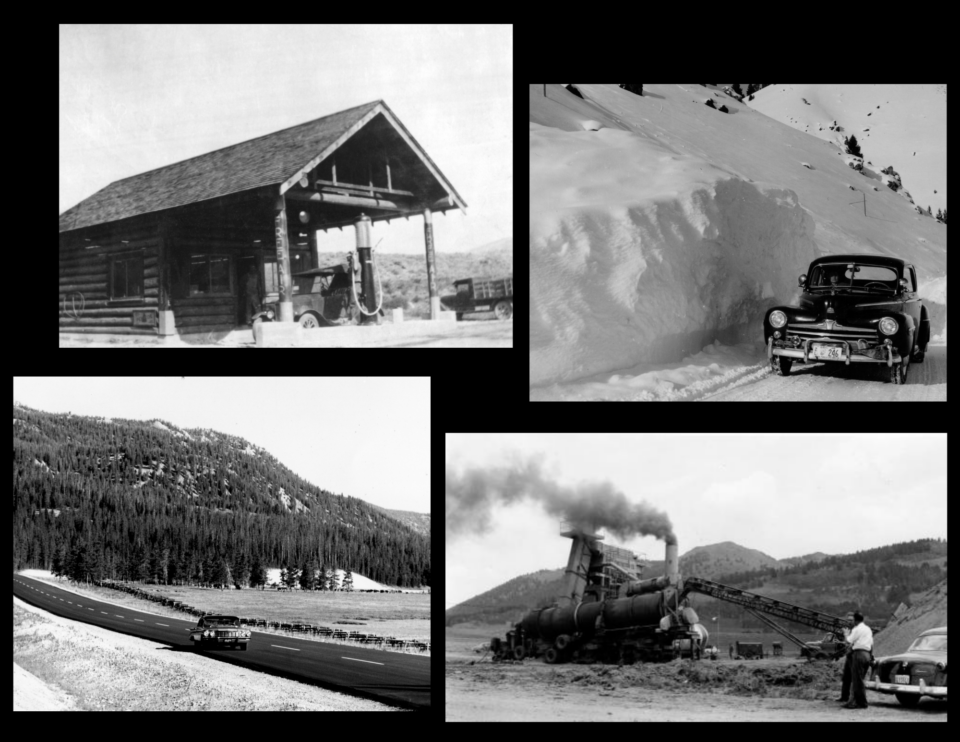
Top Left: Early photo of Riverside Service in Stanley (SIHA) – Top Right: HW 75 below Lower Stanley 1940s (ITD) – Bottom Left: New HW 21 Cape Horn (ITD) – Bottom Right: Asphalt Plant Near Smiley Creek 1955 (ITD)
The Federal Aid Road Act (FARA), signed in 1916, was the first legislation to assist states in constructing and improving their highways. The act required states to maintain a highway department and to match funds 50-50. While Idaho had established its own State Highway Commission (SHC) in 1913, it wasn’t until a 1919 property tax that Idaho could consistently match and receive federal funds for its burgeoning highways.
In 1914, Idaho’s new SHC created the State Highway System (SHS), a designation system intended to direct funds to build and maintain roads that serve markets and populations across the state. The “Sawtooth Park Highway”, stretching from Twin Falls to Hailey, was the sixth and last route included. Two years later, that highway designation was extended through the Sawtooth Valley to Challis downstream. Despite name changes over its history, the entire route now called Highway 75 was established as an official highway in 1916.
The Federal Aid Highway Act (FAHA) of 1921 reorganized the highway system again. This act increased funding to support 7% of a state’s total road miles, with 3% going to primary/interstate routes and 4% going to secondary routes – both 21 and 75 were classified as secondary routes. While road expansion and improvements continued throughout the 1920s, limited resources and more trafficked routes left our mountain roadways underdeveloped for cars. A 1926 report noted that Highway 75 from Galena to Challis was an “important unfinished segment” of the SHS and that the Forest Highway from Lowman to Stanley (present-day Highway 21) was impassable.
One important category of federal funding for highways established in 1916 was known as Forest Aid, which was funding that would cover 100% of the construction costs of Forest Highways, roads “adjacent to or within national forests, including roads contiguous to and approaching the forests”. This funding classification was extremely beneficial for Idaho, as nearly 40% of the state is national forest land. Since both Highway 21 and 75 traverse multiple forests, the limiting factor wasn’t money, but manpower. However, that was about to change.
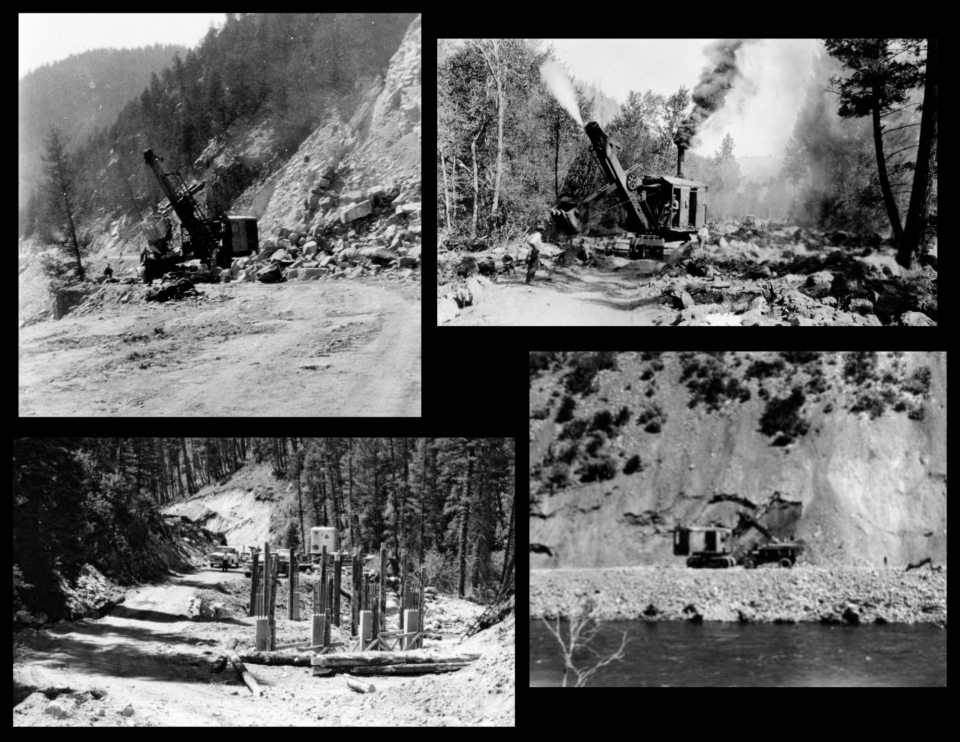
Top Left & Right: 1930s Road work near Stanley (SIHA) – Bottom Left: Highway 21 Construction (ITD) – Bottom Right: Salmon River Highway Construction 1935 (ITD)
FDR’s New Deal agenda passed during the Great Depression spurred the creation of agencies intended to get millions of Americans back to work, including the Civilian Conservation Corps and the Works Progress Administration. A major effort of these agencies was to improve road access across the country. Nationwide, between 35 and 45% of workers under federal relief programs worked on roads, with Idaho having the largest number of CCC camps per population.
Between 1930 & 1940, Idaho saw a huge improvement in its road quality thanks to the CCC. While Idaho’s SHS only expanded 300 miles during this period, its paved/oiled roads increased 287% from 990 miles to 2,842 miles, and its unimproved roads decreased 64% from 1,197 miles to 432 miles. This work included entirely grading Highway 21, paving Highway 75 from Twin Falls to Galena Summit, and graveling the highway to Challis. But pavement wouldn’t enter the Sawtooth Valley until 1955.
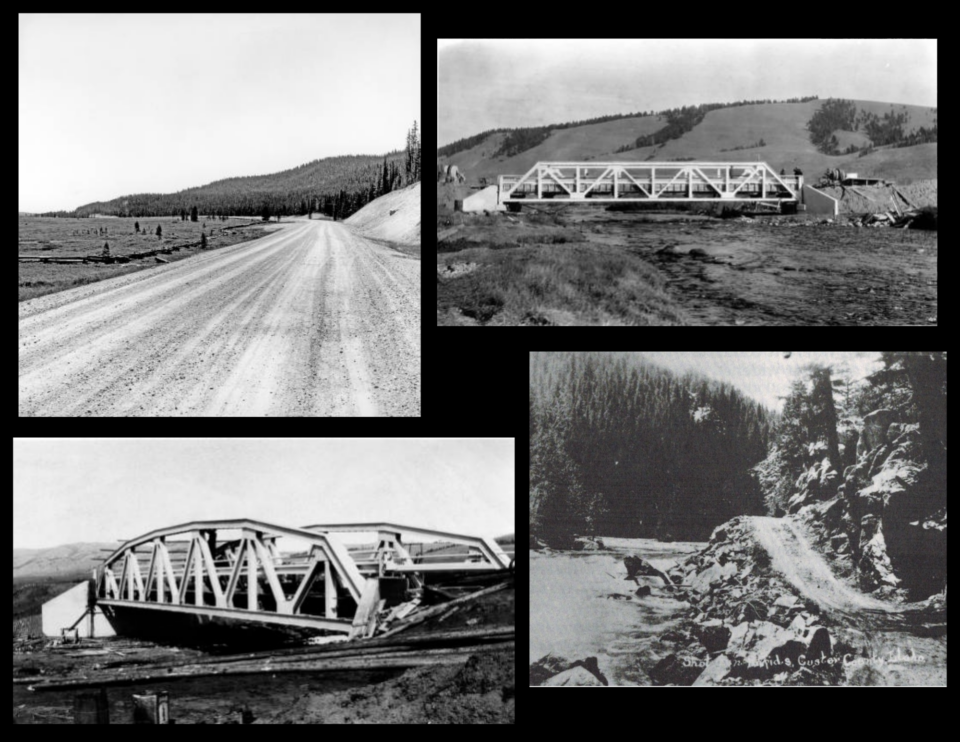
Top Left: HW 21 near Trap Creek 1966 (ITD) – Top Right: Steel bridge across Valley Creek 1927 (ITD) – Bottom Left: Bridge across the Salmon at Blaine/Custer County Line 1927 (ITD) – Bottom Right: First road up the Salmon River ~1890s (Stanley/Sawtooth Country)
The early 1950s saw an explosion in demand for highway funds. WWII rationing left highway departments understaffed, underfunded, and roadways underserviced. This deterioration combined with the sharp rise in vehicle registration after the war left Idaho highways in need of major upgrades. In 1954, the highway department studied the needs of all public roadways in the state. Their report estimated a 10-year budget cost of $583 million, $360 million of which was intended for the State Highway System. The study concluded that “needs are far greater than revenues”, $190 million greater, in fact. Luckily, a renaissance in federal highway funding was about to occur.
In 1956, concerned about national defense, President Eisenhower signed two monumental pieces of highway legislation: the Federal-Aid Highway Act (aka the Interstate Highway Act) & the Highway Revenue Act. These acts authorized $25 billion to be spent over the next 14 years, standardized highway design, and set a new federal match rate for interstate highways at 90-10. The next year, Idaho’s funding doubled from $5.2 to $10.9 million, and the state went on to receive 10% of all additional Forest Highway funds. Notably, a further $450,000 in Forest Highway funds was allocated in 1962 to improve Highway 21. The mid-50s to the early 70s saw the greatest expansion and improvement of highways in the state to date. But nothing lasts forever.
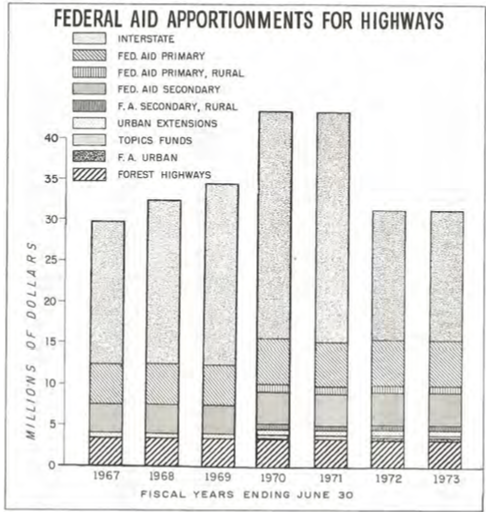
Federal aid apportionments for various highway types in Idaho (ITD).
The oil crisis of 1973-74 created funding uncertainty as asphalt and gas prices rose and gas tax revenues, earmarked for the highway department, fell. This flux in funds persisted for years, making new construction difficult. By the mid-80s, all highway funds raised by the state were used for maintenance, with new highway construction being paid solely with federal funds. Since 1988, Idaho has raised its gas tax by 18 cents per gallon to support Idaho Transportation Department budgets.
The last major federal legislation to impact Highway 21 & 75 was in 1991 with the Intermodal Surface Transportation Efficiency Act (ISTEA). This law allocated funds for environmental enhancements and created the scenic byway system. Scenic byway grants fund interpretive information, overlooks, pullouts, and safety improvements – a useful program in Idaho, where we have over 2,500 miles of scenic byways.
How the federal government appropriates funds has changed a lot since our highway-building heyday, but thankfully the destinations our roads lead to haven’t. It’s a long journey to get to the Sawtooths, and the roads we take are coated in history, ever-evolving policy, and an asphalt sealant applied regularly. While a pothole might shake you up, don’t forget to appreciate just how much effort was required for that weathered mountain road to develop that beauty mark. So drive safe and enjoy the ride, and remember, it’s not the destination, it’s the journey.
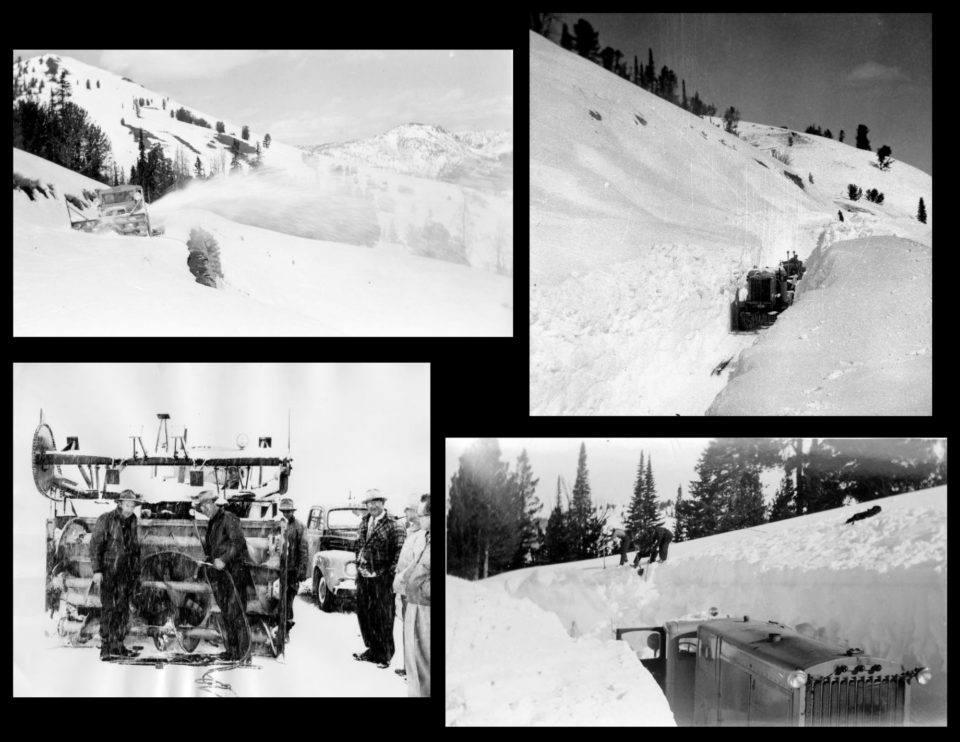
Plowing of Galena Summit in 1956 (ITD Public Archives)
References
Special thanks to the Idaho Transportation Department’s public archives for the many photos used. A complete collection of photos can be found at https://itd.contentdm.oclc.org/digital
Cush is a third-year naturalist with SIHA. He enjoys backpacking, birding, and watching the sunset behind the Sawtooths from his big front lawn.