
With their distinctive drumming and unique nests, woodpeckers are some of the most ubiquitous feathered friends spread around the World. The US houses twenty-two different species, ten of which live in Idaho, and nine of whom can be found in SNRA – Lewis’s Woodpecker is too cool for us, I guess. The species that call the Sawtooths home are the Pileated, Downy, Hairy, White-headed, American Three-toed, and Black-backed woodpeckers, the Red-naped and Williamson’s sapsuckers, and the Northern Flicker. The easiest way to start spotting them is by listening. Woodpeckers live to peck, and they do it for three reasons: breeding, feeding, and nesting.
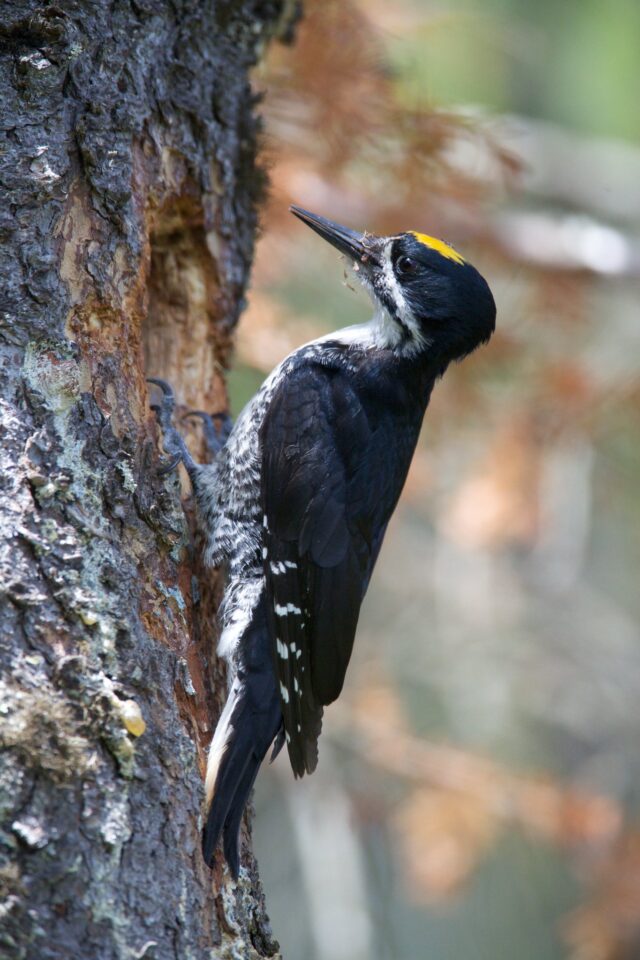
A male Black-backed Woodpecker. They prefer burn areas for camouflage Photo Cred: “Black Backed Woodpecker” by U. S. Fish and Wildlife Service – Northeast Region is marked with Public Domain Mark 1.0.
The loudest, fastest, jackhammering of successive raps you may hear is called drumming and is done for courtship. This loud “Hear Meee!” presentation is a way to stand out to a potential mate. Atypical for most animal species, this courtship behavior is displayed by both male and female woodpeckers – usually it’s only the male calling out to the females. This is also how woodpeckers establish and maintain territory. The louder the drumming, the better. Woodpeckers are smart animals, so if you hear one drumming against a gutter, they’re not confused about what they are hitting; rather, they are using that home as a stage to impress a mate.
If you hear slow, quiet, methodical hits, this is a woodpecker either hunting or excavating a cavity. Snags, or dead trees, are ideal for this as the wood is softer and can’t grow back. As they scale trees, woodpeckers listen for movement both under the bark and inside the trunk. If they hear a beetle or larvae, they’ll chisel until they find it. If you listen long enough in an area full of snags, you too can hear larvae chewing their way through the wood.
But woodpeckers’ diets are as varied as they are. While they bore into trees looking for insects, they also eat fruit, nuts, and seeds. The Northern Flicker, one of our largest woodpeckers, prefers feeding on insects found on the ground.
One of the most fascinating diets belongs to sapsuckers. Sapsuckers make small holes around the tree, boring into the phloem and xylem, where sap flows, and sugars are transported; humans do the same thing when we tap maple trees. Sapsuckers use a brush-like tongue to collect the sap as it pools out. They’ll also come back to the tree for any insects that were attracted to the sugary goodness. If you spot rings of small holes around a tree trunk, you are looking at a sapsucker’s dining table.
The last reason woodpeckers peck is to make their nests. Nest sizes and entrances vary by species, but this helps the forest as a whole. Woodpeckers make a new nest every year, so their old cavities become homes for other animals. This group of secondary nesters includes wood ducks, songbirds, squirrels, owls, raccoons, martens, and 20% of bird species globally – woodpeckers build the original birdhouses.
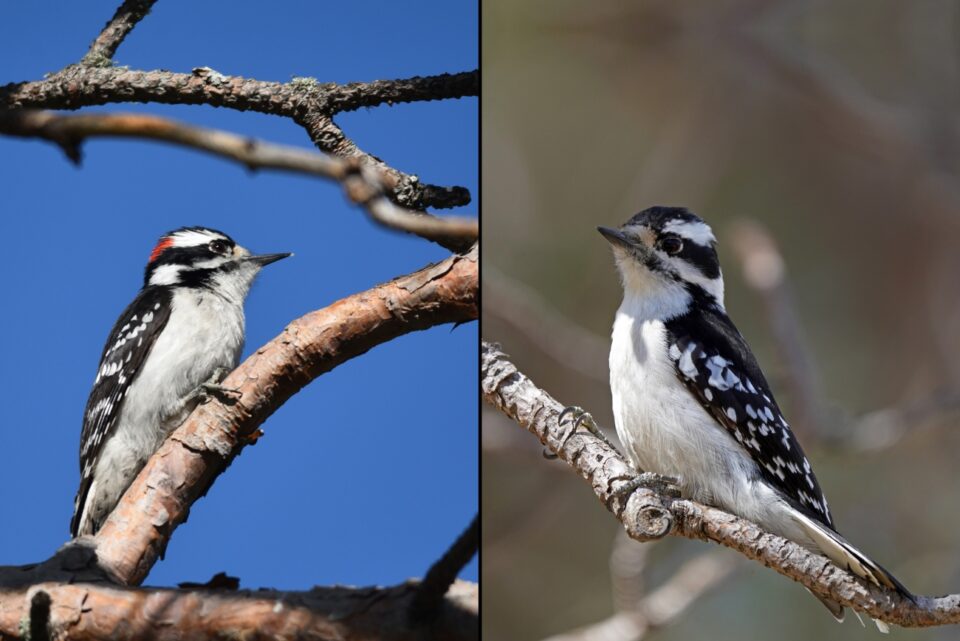
Male (left) and female (right) Downy Woodpeckers, the smallest species in the Sawtooths Photo Cred: Courtney Celley/USFWS, https://www.fws.gov/media/downy-woodpeckers-1
Stability is important for woodpeckers as they rap against trees. Woodpeckers latch onto vertical surfaces in two different ways. All species have zygodactyl feet, meaning their toes are arranged two in the front & two in the back. This X-shaped formation helps anchor them on the bark. They also have extra stiff tail feathers. These feathers spread out and press against the bark, acting as a third touch point to help stabilize them as they drum and chisel.
One issue every carpenter has is the hazard of sawdust impacting their health, but this is not a problem for woodpeckers. They have a translucent third eyelid, called the nictitating membrane, which acts as goggles to protect their eyes from flying wood chips. Their nostrils are covered by bristly feathers that prevent them from breathing in any wood. And like all birds, woodpeckers have two types of feathers, contour and downy, which protect their body from parasites, dust, and debris.
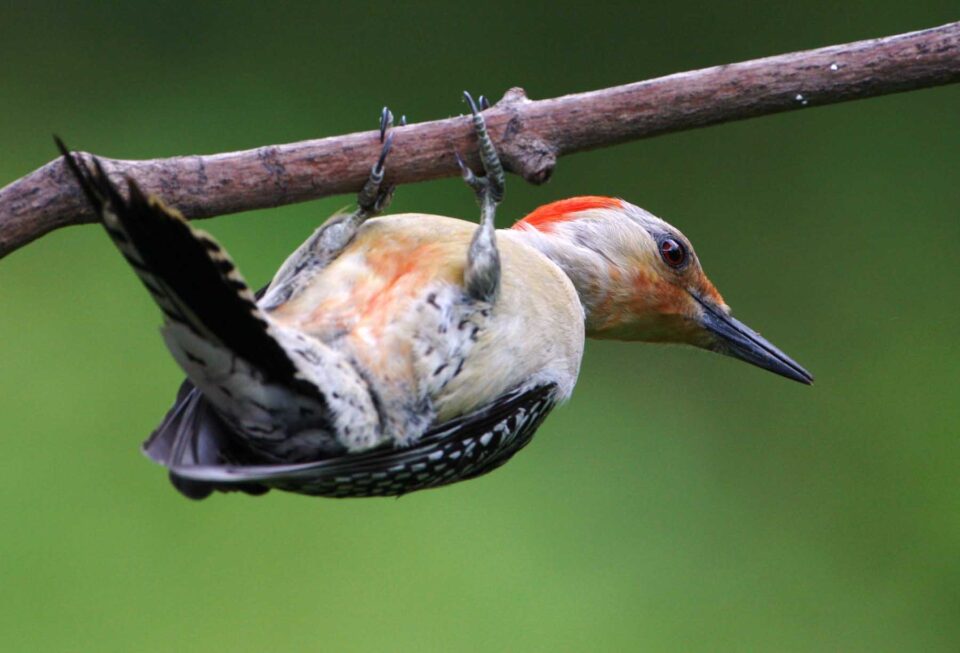
A woodpecker gripping a branch with its zygodactyl feet Photo Credit: “Red-bellied Woodpecker” by U. S. Fish and Wildlife Service – Northeast Region is marked with Public Domain Mark 1.0.
One of the most fascinating things about woodpeckers is how they can headbang (between eight and twelve thousand times a day!) without getting hurt.
Head injuries occur because deceleration happens at different rates within the head — what’s measured as g-force. At the moment of impact, the skull stops abruptly, but the brain keeps moving until it collides with the inside of the skull. The brainstem, meanwhile, decelerates at yet another rate relative to both. This mismatch in deceleration rates creates shearing strain across brain tissue. Compression occurs at the site of impact (the coup), while expansion follows on the opposite side (the contrecoup). This rippling between positive and negative pressure can damage neurons and blood cells.
But smaller brains can sustain higher g-force than larger brains. First, there is less mass for that deceleration lag to build up across; the whiplash is not as severe because there is a shorter distance for momentum to travel. That reduced mass also means less inertia to overcome, so a smaller brain decelerates and stops faster for the same force (think of the braking needed to stop a car versus a semi). These traits resulting from size allow woodpeckers to sustain around 7x more g’s than humans.
A shock-absorbent material located between the site of impact and the brain is a great way to minimize the shock of the force. This is why we wear helmets when biking or playing a contact sport; however, minimizing impact is not a winning strategy if you are hitting your head with the intent of breaking the surface.
While it has long been believed that woodpeckers have a shock-absorbing mechanism behind their bill, a study in 2022 proved this idea wrong. Unlike us, woodpeckers hit their heads on purpose. A shock-absorbent skull would be like adding a spring to a hammer…it would dampen the kinetic energy of each swing. If the skull absorbed some of the energy of its impact, woodpeckers would have to pound harder to penetrate the tree. A built-in shock absorber decreases efficiency and would be counter-productive to why they are pecking in the first place
Evolution favors more reward for less work. The more force a single peck can deliver, the less energy the bird has to spend to reach its food. Woodpeckers actually stiffen their body before each strike, enabling them to hit the wood straight-on, which increases the amount of energy they deliver with each blow. While there is a “spongy” seeming structure at the coup and contrecoup, this web of bone helps spread out the stress put on the skull to reduce the chance of fracturing -– like reinforcing joints on a bridge to more evenly distribute the load.
Woodpeckers play an important role in the ecosystem, managing pests, building homes, and recycling nutrients. Plus, their loud lifestyle makes them one of the easiest birds to start spotting.
Sources
https://idfg.idaho.gov/old-web/docs/wildlifeExpress/2011nov.pdf
10 Species of Woodpeckers in Idaho – Birdwatching Central
https://birdwatchingcentral.com/woodpeckers-in-idaho/
Woodpeckers minimize cranial absorption of shocks: Current Biology
https://www.cell.com/current-biology/fulltext/S0960-9822(22)00855-7
Adaptions
Woodpecker Adaptations – WVDNR
8 Wonky and Wonderful Woodpecker Adaptations – The National Wildlife Federation Blog
Cush is a third-year naturalist with SIHA. He enjoys backpacking, birding, and watching the sunset behind the Sawtooths from his big front lawn.